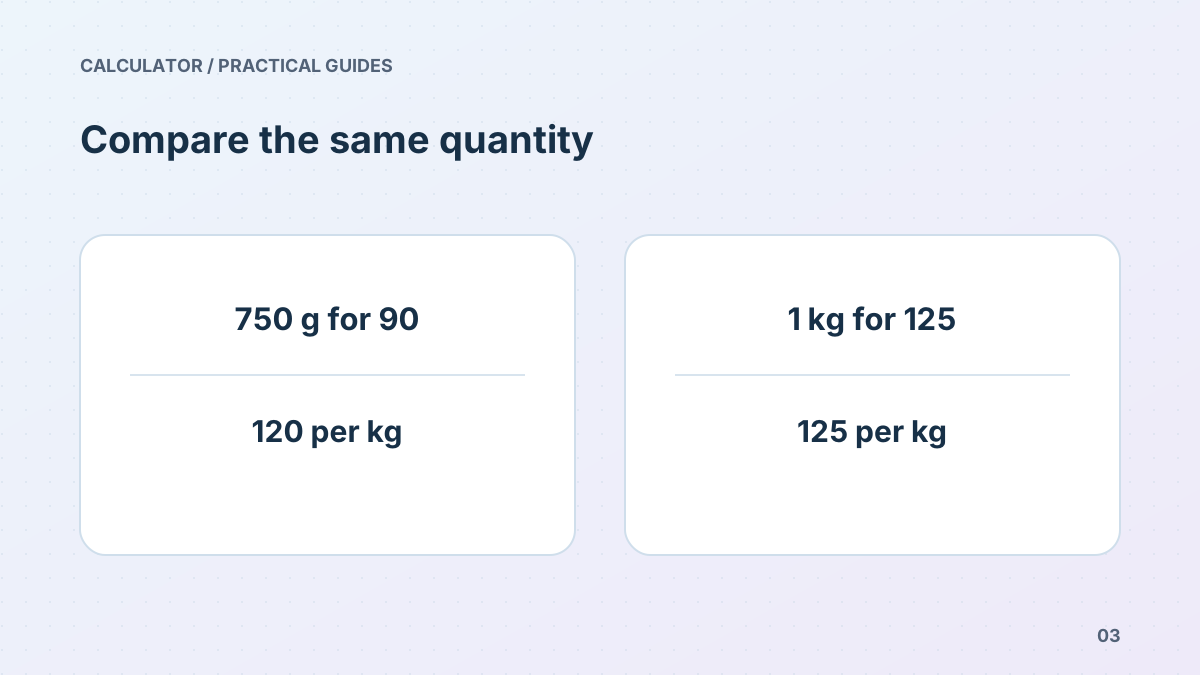
A 750 g pack costs 90, while a 1 kg pack costs 125. The larger pack costs more, but that fact alone does not tell you which is better value. On a common basis, the smaller pack costs 120 per kilogram and the larger one costs 125 per kilogram.
A unit price is the cost for one standard amount, such as a kilogram, litre, sheet, or item. It separates the price comparison from the package size, helping you compare offers that otherwise look unrelated.
Choose a common unit before dividing
The formula is unit price = total price ÷ total quantity. If you want a price per kilogram, convert 750 g to 0.75 kg. Then 90 ÷ 0.75 = 120 per kg. The other pack is 125 ÷ 1 = 125 per kg.
You can instead compare per 100 g: the first pack costs 12 per 100 g and the second 12.50 per 100 g. Either basis works as long as it is the same for both products.
A common mistake is dividing one price by grams and the other by kilograms. The resulting numbers may differ by a factor of 1,000. Write the unit beside every intermediate quantity to catch that error.
Multipacks need their total usable quantity
A multipack containing six 250 mL bottles holds 1,500 mL, or 1.5 L. If it costs 180, its price is 180 ÷ 1.5 = 120 per litre. A single 1 L bottle at 130 therefore has a higher unit price.
For items sold by count, calculate the total number of comparable items. Four packets of eight batteries contain 32 batteries. But do not treat different battery types, paper thicknesses, or concentrated products as identical just because their counts are easy to compare.
Include costs and waste that affect your purchase
If a delivery charge applies only to one option, add it before dividing when comparing your actual purchase. A refundable deposit may need a separate comparison because it is not necessarily a permanent cost.
A low unit price is useful only for quantity you can use. A 2 kg pack at a lower price per kilogram may be poor value if half spoils. To explore that issue, divide the purchase cost by the quantity you expect to use, while making your waste assumption explicit.
Check quality as well as arithmetic
Unit pricing does not compare ingredients, durability, concentration, or suitability. A detergent designed for twice as many washes may need a price-per-wash comparison instead of price per litre. Check the stated dose rather than assume all liquids have the same strength.
Keep full precision until the last step, then round consistently. When two options have almost identical unit prices, other practical factors may matter more than a tiny rounded difference. Use unit price as a clear comparison tool, then consider how the product fits the purchase you actually need.
Try the calculation
Use the Unit Price Calculator with your own inputs. Check units, assumptions, and the worked example before interpreting a result.