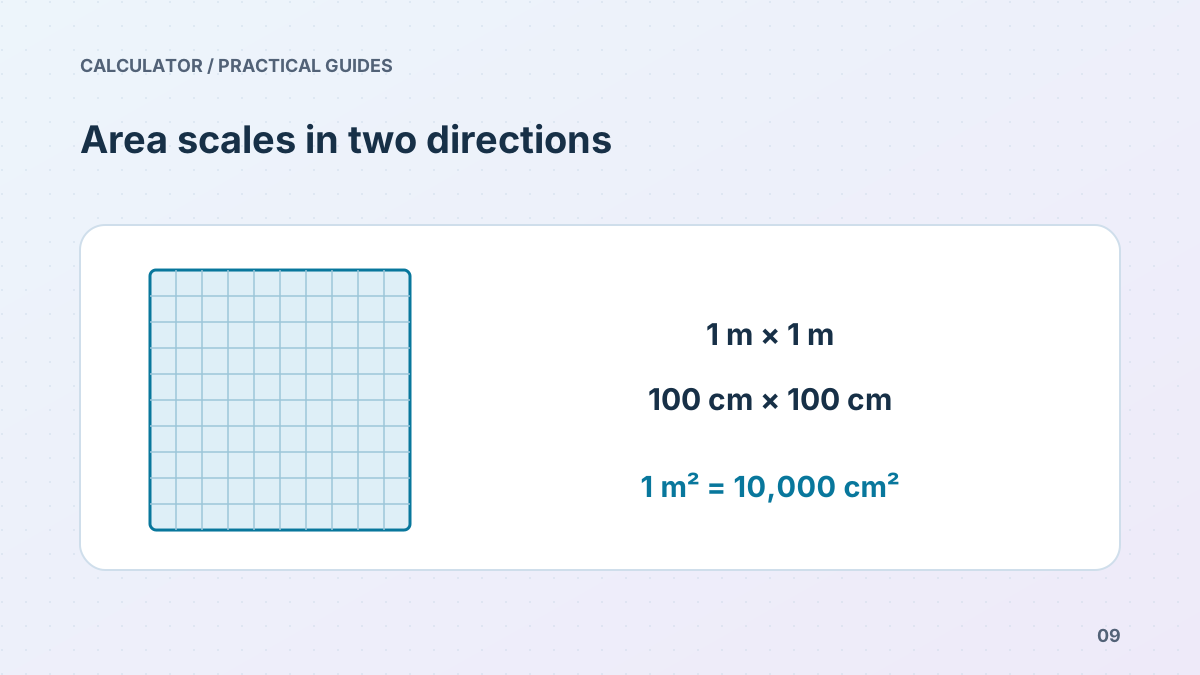
One metre is 100 centimetres, but one square metre is 10,000 square centimetres. Area has two dimensions, so a length conversion factor applies twice. This is a common source of large errors in room plans, product specifications, and worksheets.
Picture a square with sides of one metre. Each side is also 100 centimetres. Its area is therefore 100 × 100 = 10,000 square centimetres, not 100 square centimetres.
Square the length conversion factor
If one length unit equals k of another, one square unit equals k² square units. Since 1 m = 100 cm, the area factor is 100² = 10,000. Thus 3 m² = 30,000 cm².
For the reverse direction, divide by the squared factor. An area of 25,000 cm² is 25,000 ÷ 10,000 = 2.5 m². Converting to a larger area unit should make the numerical value smaller.
You can check the dimensions by writing the conversion explicitly: 3 m² × (100 cm / 1 m)². The metres cancel, leaving square centimetres. The squared notation is doing useful work rather than merely decorating the number.
Do not confuse area with perimeter
A rectangle measuring 3 m by 4 m has an area of 12 m² and a perimeter of 14 m. Area describes the enclosed surface; perimeter describes the distance around it. They use different units and answer different questions.
Convert that rectangle’s sides to 300 cm and 400 cm. Its area is 120,000 cm², equivalent to 12 m². Its perimeter is 1,400 cm, equivalent to 14 m. Perimeter uses the ordinary length factor, not the squared factor.
Convert dimensions before multiplying when needed
If one side is given as 2 m and another as 50 cm, put them in a common unit first. In metres, the calculation is 2 × 0.5 = 1 m². In centimetres, it is 200 × 50 = 10,000 cm².
Multiplying 2 by 50 and calling the result 100 m² would mix units. Keep units attached to dimensions, especially when reading a drawing that combines centimetres, millimetres, and metres.
Separate geometry from material quantities
An area conversion does not decide how much material to buy. Flooring layouts, cuts, overlapping sheets, wastage, and pack sizes are separate inputs. First calculate and convert the measured area, then apply any clearly stated allowance.
For a 12 m² surface with a hypothetical 10% allowance, the arithmetic requirement is 13.2 m². Buying whole packs may require a further rounding step. Keep the measured area and the allowance separate so that anyone reviewing the estimate can see what each number means.
Before accepting a result, check the direction of the conversion, confirm that the unit is squared, and estimate its scale. A smaller square unit requires more units to cover the same physical surface.
Try the calculation
Use the Area Converter with your own inputs. Check units, assumptions, and the worked example before interpreting a result.