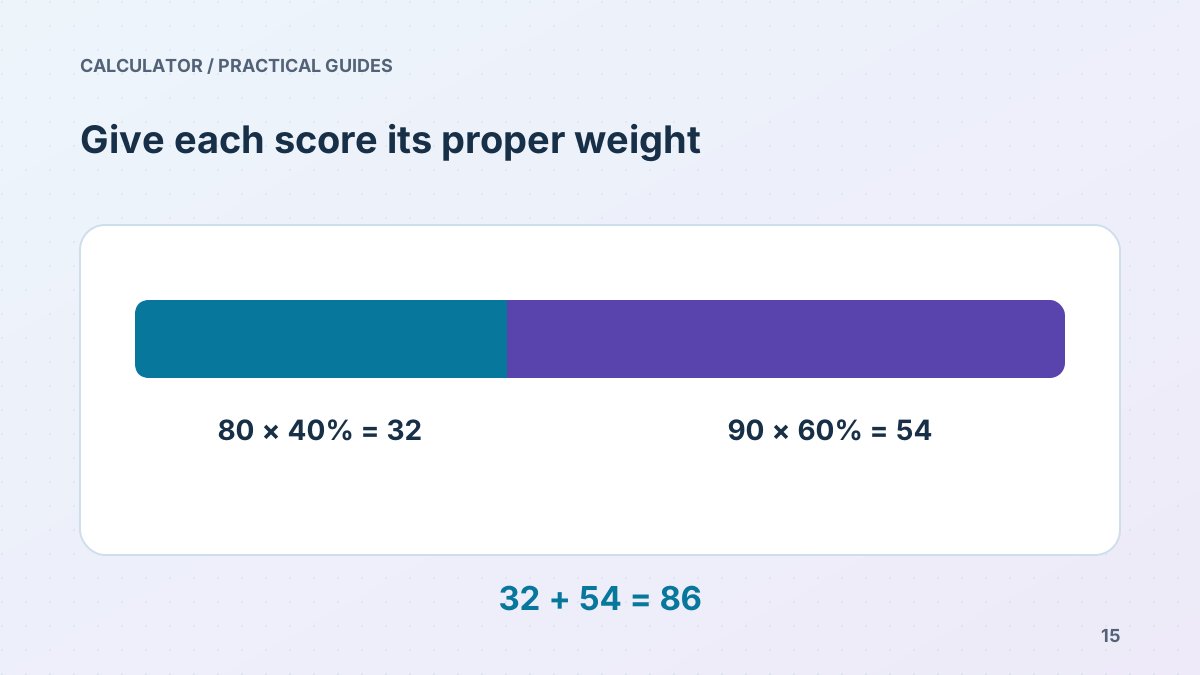
Two scores, 80 and 90, have a simple average of 85. If the first counts for 40% and the second for 60%, the weighted average is 86. The higher score has more influence because it carries more weight.
A weighted average is useful whenever observations represent different quantities or have different importance. Weights can be percentages, counts, credits, distances, or other positive quantities appropriate to the question.
Multiply, add, then divide by total weight
The general formula is weighted average = sum of (value × weight) ÷ sum of weights. For weights 40 and 60, calculate (80 × 40 + 90 × 60) ÷ (40 + 60) = 86.
If you write the weights as decimals 0.40 and 0.60, their sum is one, so 80 × 0.40 + 90 × 0.60 = 86. Both methods are equivalent when the weights describe the same proportions.
Do not mix a weight of 40 with a weight of 0.60. One is on a percentage scale and the other on a decimal scale. Keep all weights on the same basis.
Weights need not total 100
Suppose three assessment scores are 70, 80, and 90 with weights of 1, 2, and 3. The weighted total is 70 + 160 + 270 = 500, and the total weight is 6. The average is 500 ÷ 6, approximately 83.33.
You could normalize those weights to fractions of six, but you do not have to. Dividing by the weight total does the normalization. If all weights are equal, the formula reduces to the ordinary arithmetic mean.
Group averages need group sizes
A group of 10 people has an average score of 70, while a group of 30 has an average of 90. Averaging the two group averages gives 80, but that treats both groups as equally large.
The combined average is (70 × 10 + 90 × 30) ÷ 40 = 85. The group sizes are the weights. Without those sizes, you cannot generally recover the combined average from the two means alone.
Check whether weighting answers the intended question
For an overall average price paid per item, item counts may be the appropriate weights. For an average speed over a journey, time is relevant; total distance divided by total time is often the clearest calculation. Choose weights based on the quantity you want to summarize.
If a course defines assessment weights, use those published weights and its rules for missing work. Do not invent equal weights because they are convenient. A zero weight removes an item’s influence, but an all-zero set of weights makes the denominator zero and the average undefined.
With nonnegative weights and at least one positive weight, the result should lie between the smallest and largest included values. A result outside that range is a useful sign to check the inputs, arithmetic, or weight convention. State both the values and weights so another person can reproduce your answer.
Try the calculation
Use the Homepage calculator with your own inputs. Check units, assumptions, and the worked example before interpreting a result.