A temperature conversion needs more than a multiplication. Celsius and Fahrenheit have different step sizes and different zero points. To convert a reading, you must account for both.
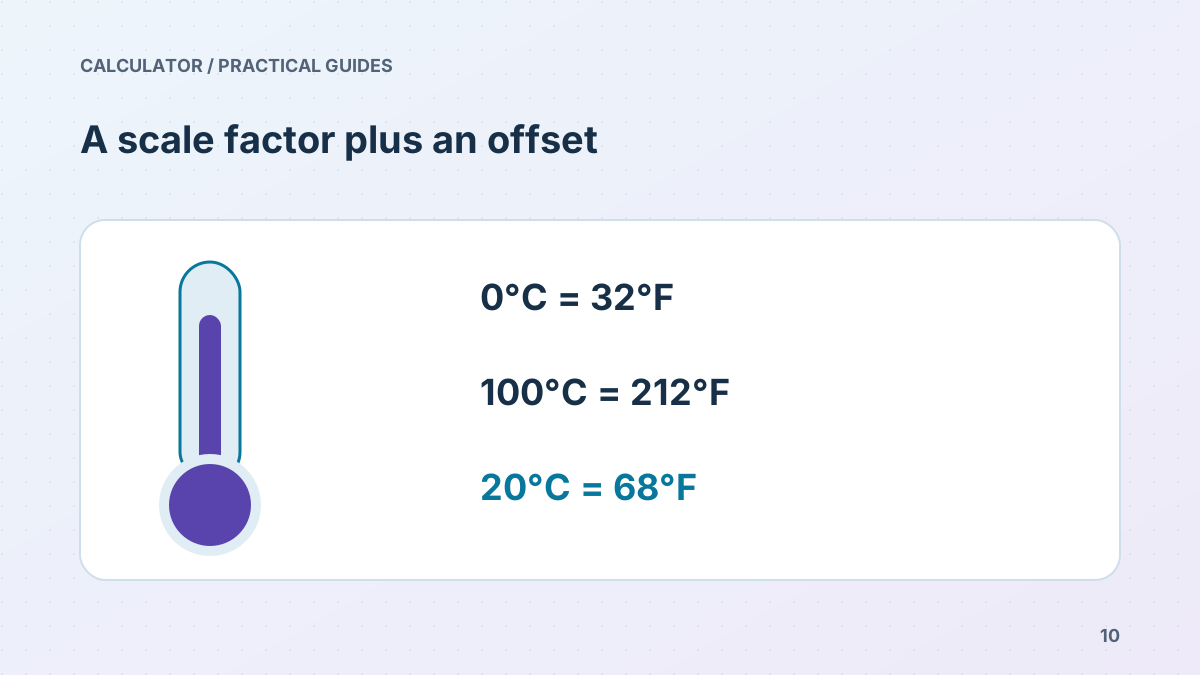
A useful check is that 0°C corresponds to 32°F. Multiplying zero by a conversion factor cannot produce 32, which immediately shows why an offset belongs in the formula.
Convert a temperature reading
The formulas are °F = °C × 9/5 + 32 and °C = (°F − 32) × 5/9. Multiply or divide in the stated order, and keep the brackets in the reverse conversion.
For 20°C, calculate 20 × 1.8 + 32 = 68°F. For 68°F, subtract 32 first to get 36, then divide by 1.8 to get 20°C. Doing 68 ÷ 1.8 − 32 applies the operations in a different order and gives the wrong answer.
The reference points 0°C = 32°F and 100°C = 212°F are useful arithmetic checks. The conversion equations are exact relationships between the scales; a measured temperature may still have instrument uncertainty.
A temperature change does not use the offset
Suppose a room changes from 20°C to 25°C. The increase is 5 Celsius degrees. The Fahrenheit readings are 68°F and 77°F, so the increase is 9 Fahrenheit degrees.
For an interval, use Fahrenheit change = Celsius change × 1.8. The offset cancels when subtracting the two readings. Adding 32 to a five-degree change would incorrectly treat the interval as an absolute reading.
This distinction matters in experiments and specifications that describe a rise, a fall, or an allowable temperature difference. Label the result as a change or interval rather than leave readers to guess.
Kelvin adds another zero point
Kelvin and Celsius have the same size step, but their zero points differ. A Celsius reading converts with K = °C + 273.15. Thus 20°C corresponds to 293.15 K.
A rise of 5°C is a rise of 5 K. Kelvin is written K, without a degree symbol. The fact that interval sizes match does not make the numerical readings equal.
Check the context and rounding
For a weather reading, a whole-number result may be sufficient. For a laboratory calculation, preserve the precision supported by the measurement. An exact conversion factor does not create extra information that the thermometer did not measure.
Before using the result, ask whether you are converting a reading or a difference, identify the input scale, and check a familiar reference point. These three checks catch most ordinary temperature-conversion errors.
Reference: NIST’s temperature units guidance distinguishes temperature scales and their interval sizes.
Try the calculation
Use the Temperature Converter with your own inputs. Check units, assumptions, and the worked example before interpreting a result.