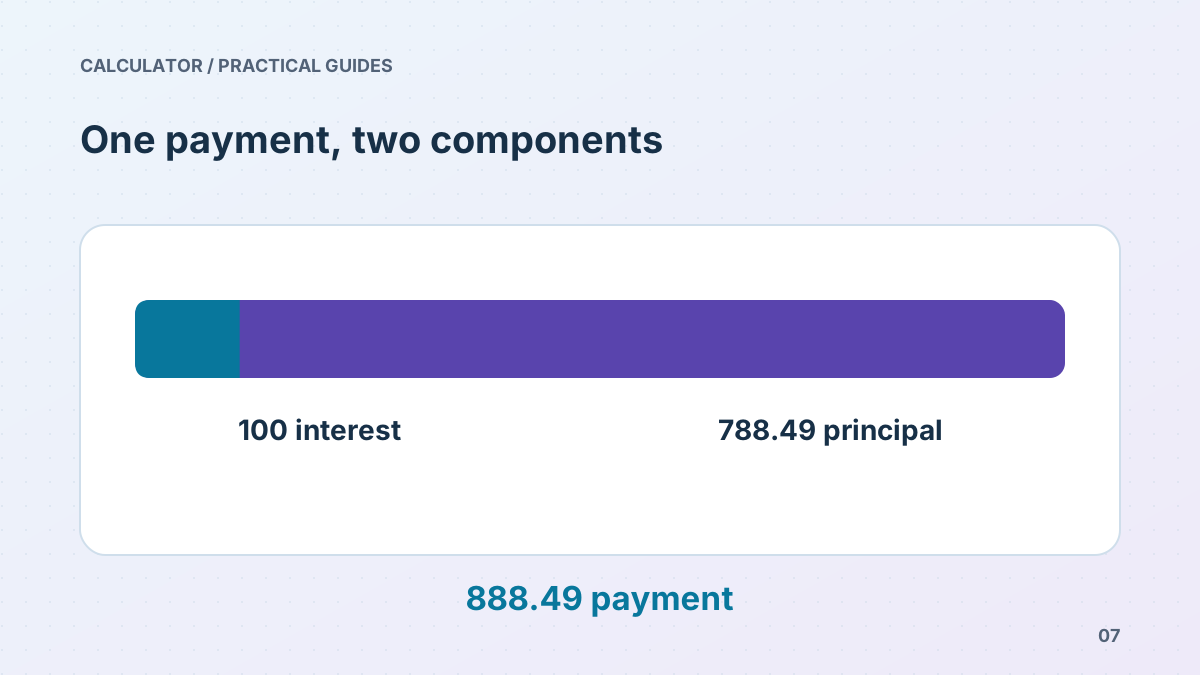
A loan payment is not necessarily all repayment of the amount borrowed. In a standard amortizing loan, part covers interest for the period and part reduces the principal. That split changes as the remaining balance changes.
Consider a simplified fixed-rate loan of 10,000, repaid over 12 months at a nominal annual rate of 12%, using a monthly rate of 1%. Assume equal end-of-month payments and no fees. The numbers explain the mechanism; they are not a lending offer.
Calculate the fixed payment
A common payment formula is payment = P × r ÷ [1 − (1 + r)−n], where P is the original principal, r is the rate per payment period, and n is the number of payments.
Using P = 10,000, r = 0.01, and n = 12 gives a payment of approximately 888.49. The annual percentage must be converted to a decimal and then to the payment-period rate according to the model.
If the periodic interest rate is zero, the ordinary formula needs a separate case: payment equals principal divided by the number of payments. For this example at zero interest, that would be 10,000 ÷ 12.
Break down the first two payments
The first month’s interest is 10,000 × 0.01 = 100. With a rounded payment of 888.49, the principal portion is 788.49, leaving approximately 9,211.51.
The following month’s interest is approximately 9,211.51 × 0.01 = 92.12. The same payment now repays roughly 796.37 of principal. Interest takes a smaller share because the outstanding balance is lower.
Over the schedule, use full precision internally and the agreement’s rounding rules. Small differences may require an adjusted final payment. A schedule that displays rounded rows can also differ by a cent when you add those displayed rows.
Separate interest from other charges
A real monthly amount may include insurance, taxes, service charges, or other items beyond principal and interest. A principal-and-interest calculator does not automatically include them. Compare its inputs with the lender’s actual repayment schedule.
Also distinguish an interest rate from APR or another disclosure measure. Fees and rate conventions can affect that comparison. An interest-only period, variable rate, balloon payment, or irregular first period does not fit this simple schedule unchanged.
Use the schedule to answer a specific question
An amortization table helps you see the balance after a given payment, the accumulated interest, and the distribution of future payments. It does not determine whether the loan is affordable for your circumstances.
If testing an extra payment, confirm whether it reduces principal and whether any restrictions or charges apply. Treat the calculated schedule as a model, then verify it against the contract before relying on it.
The Consumer Financial Protection Bureau explains principal, interest, and mortgage amortization. Its discussion provides context for how payments reduce a balance.
Try the calculation
Use the Loan Amortization Calculator with your own inputs. Check units, assumptions, and the worked example before interpreting a result.