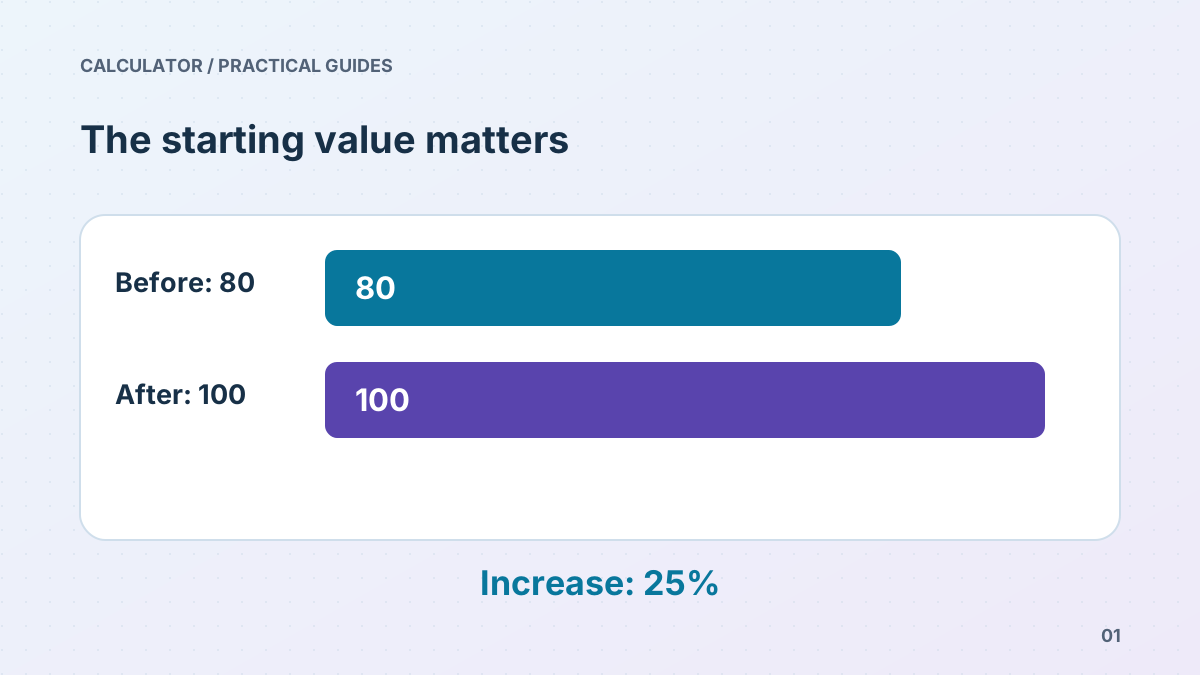
A price rises from 80 to 100. The difference is 20, but the percentage increase is 25%. If that same price later falls from 100 to 80, the decrease is 20%. There is no contradiction: each calculation divides the change by a different starting amount.
Percentage change describes a difference relative to where you began. This makes it useful for comparing prices, quantities, and results that have different scales. The first step is to identify the original value, rather than choose whichever number happens to be larger.
The formula and a worked example
Use percentage change = (new value − original value) ÷ original value × 100. A positive result indicates an increase; a negative result indicates a decrease.
For 80 becoming 100, subtract to get 20, divide by 80 to get 0.25, and multiply by 100 to get 25%. For 100 becoming 80, the difference is −20; dividing by 100 gives −0.20, or −20%. In prose, you can call that a 20% decrease.
Keep the original and new values in the same units. Comparing a monthly amount with a yearly amount without first converting them creates a misleading result, even when the arithmetic itself is correct.
Percentage points are a different measure
Suppose a rate moves from 10% to 12%. The difference is 2 percentage points. Relative to the old rate, the increase is (12 − 10) ÷ 10 × 100 = 20%. Both statements can be correct, but they describe different quantities.
When reporting a change in a percentage, name the measure explicitly. “Up by 2%” is ambiguous in this example. “Up by 2 percentage points, from 10% to 12%” makes the comparison clear.
Why equal rises and falls do not cancel
Start with 100. Increasing it by 20% gives 120. Reducing 120 by 20% gives 96, because the second change applies to 120. Written as multipliers, the calculation is 100 × 1.20 × 0.80 = 96.
To recover from 80 to 100, you need a 25% increase. A 20% decrease and a 25% increase can therefore undo one another. This is the same starting-value issue, not a special rule about prices.
Check unusual starting values
A starting value of zero makes the usual formula undefined: you cannot divide by zero. Say “increased from 0 to 15” rather than inventing a percentage increase. Negative starting values also require care because the sign may not describe improvement in the way a reader expects.
For a useful report, give the original amount, the new amount, the absolute difference, and the percentage change. Round the final percentage to an appropriate precision, but keep extra digits during the calculation. That combination makes the result easy to reproduce and much harder to misinterpret.
Try the calculation
Use the Homepage calculator with your own inputs. Check units, assumptions, and the worked example before interpreting a result.