Rounding makes numbers usable, but it also removes information. A small change in one intermediate value can affect a final total, especially when a calculation repeats many times. Knowing when a number was rounded is often as useful as knowing how many decimals it displays.
For everyday estimates, keeping extra precision during the calculation and rounding the final answer is a sensible starting point. In invoices, statements, and contracts, however, an established rounding rule may require a different sequence.
Intermediate rounding can change the answer
Divide 10 by 3 and multiply by 3. Using the exact fraction gives 10. Rounding the intermediate value to 3.33 gives 3.33 × 3 = 9.99. The missing cent comes from the rounding step, not a broken multiplication rule.
In a multi-step calculation, store the unrounded number if the tool allows it. Display a shorter value for readability, but use the fuller value in later steps. If you copy a displayed value into another calculator, remember that it may already be rounded.
Rounding items and rounding totals are different
Imagine three calculated line amounts of 1.004 each. Rounding each line to two decimals gives 1.00 + 1.00 + 1.00 = 3.00. Adding the unrounded amounts first gives 3.012, which rounds to 3.01.
Either sequence may match a particular system’s rules. When reproducing an invoice or tax calculation, use that system’s specified method rather than assume every calculator rounds in the same place. The issue is the procedure, not merely the number of decimal places.
Distribute remainders visibly
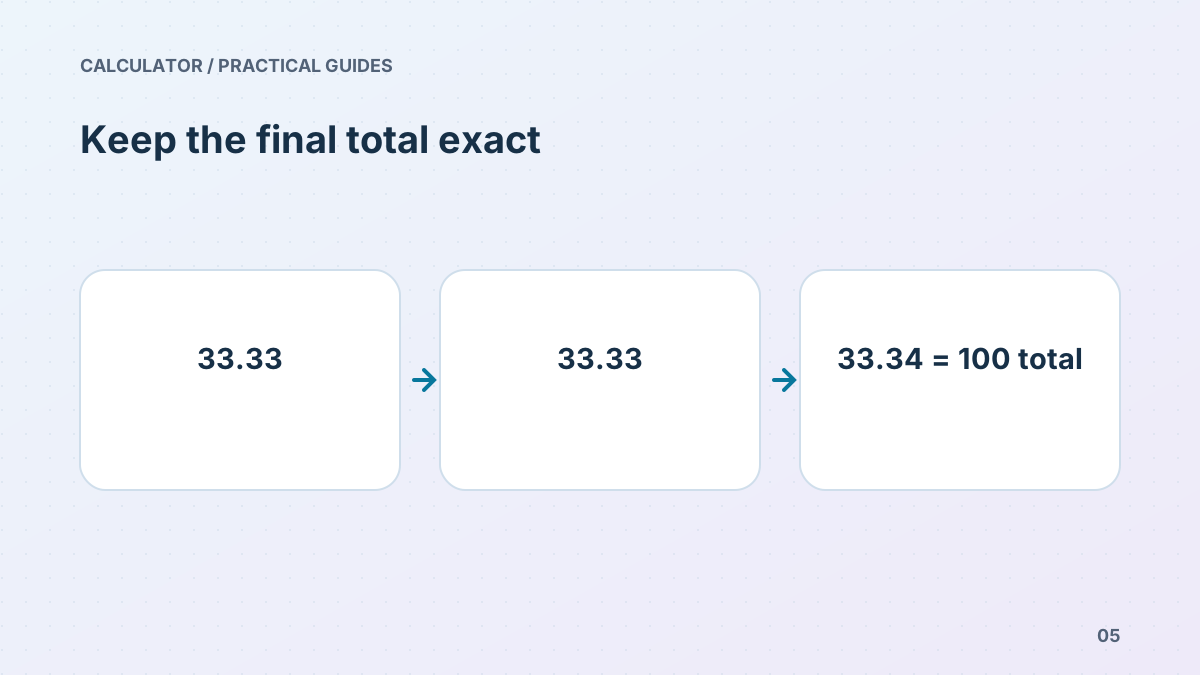
Split 100 equally among three people. At two-decimal precision, payments of 33.33, 33.33, and 33.34 total exactly 100. Reporting three identical rounded shares of 33.33 does not settle the last cent.
A useful allocation method is to round down the shares initially, calculate the remaining smallest currency units, and distribute those units according to an agreed rule. For an equal split, assigning the extra cent to one person is simple. For a proportional split, document the allocation method.
Match precision to the purpose
Two decimals are common for some currencies, but currency conventions differ. Measurements also have their own precision. A result of 1.234567 metres does not mean a tape measure supplied information at that precision.
Some software uses round-half-even while other tools round a halfway value away from zero. Binary floating-point can also represent a decimal approximately. If a halfway case matters, check the documented rule and test it directly.
When explaining a result, state the original inputs, the formula, the rounding stage, and the precision used. Those details let another person reproduce the answer. More displayed digits are not automatically more accurate; consistent calculations and an appropriate final precision matter more.
Try the calculation
Use the Homepage calculator with your own inputs. Check units, assumptions, and the worked example before interpreting a result.