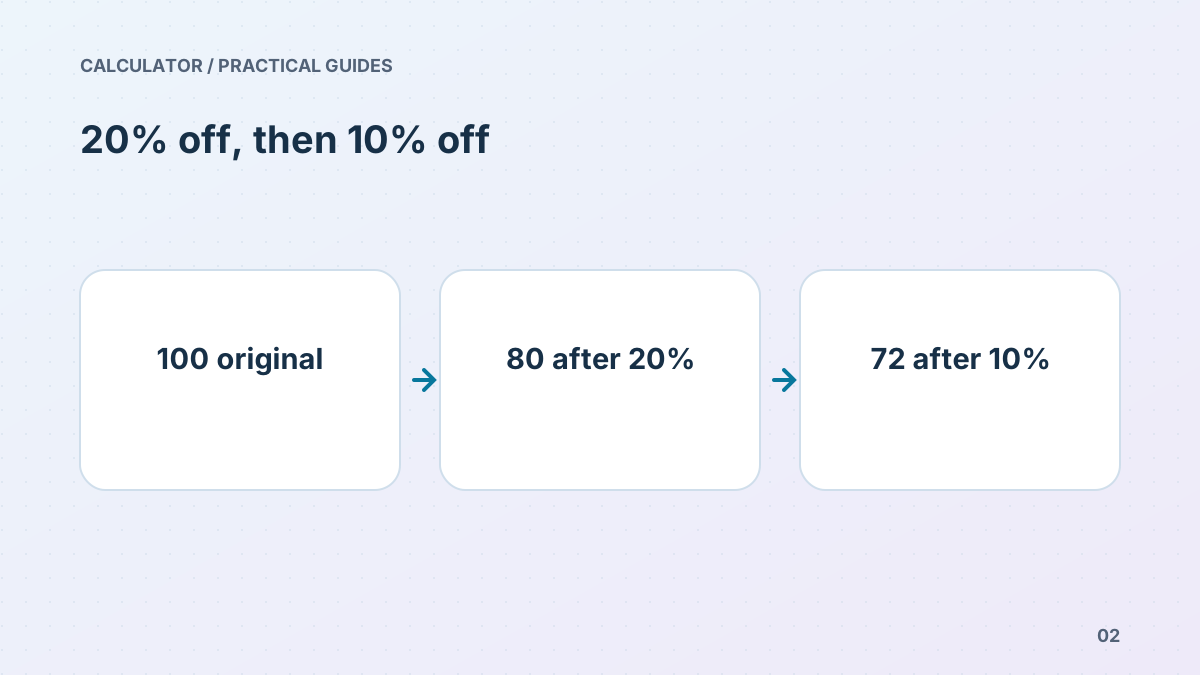
A shop offers 20% off, followed by an extra 10% off. On an item originally priced at 100, the final price is 72, not 70. The second discount applies to the reduced price, so the combined saving is 28%.
This distinction matters whenever offers are applied in stages. Percentage reductions, fixed coupons, delivery charges, and taxes can all use different bases. Before calculating, check which parts of the order each offer applies to.
Turn each discount into a multiplier
A 20% discount means you pay 80% of the price, so its multiplier is 0.80. A 10% discount has a multiplier of 0.90. The final price is original price × 0.80 × 0.90.
For an original price of 100, the stages are 100 × 0.80 = 80, then 80 × 0.90 = 72. The saving is 100 − 72 = 28. Dividing that saving by the original price confirms an effective discount of 28%.
You can extend the method to three or more percentage offers. Multiply the amount by the remaining-price fraction for each stage. Do not add the percentages unless the offer explicitly says they all apply independently to the original price.
A useful shortcut for the effective discount
For two discounts expressed as decimals a and b, the effective discount is 1 − (1 − a)(1 − b). With a = 0.20 and b = 0.10, that becomes 1 − 0.80 × 0.90 = 0.28.
The order of two percentage-only discounts does not change the result when both apply to the same item without intermediate rounding. However, the order can matter if one offer is a fixed amount or if the shop rounds the price after each stage.
Fixed coupons change the order question
Take a price of 100, a 20% discount, and a coupon worth 10. Applying the percentage first gives 80 − 10 = 70. Applying the coupon first gives (100 − 10) × 0.80 = 72.
Neither calculation tells you the store's actual policy. The offer terms decide the sequence and whether coupons cover delivery or taxes. Use the checkout total to confirm the real price rather than assume the most favorable order.
Recover the original price correctly
If a final price of 72 includes a 20% discount followed by 10%, divide by the combined multiplier: 72 ÷ 0.72 = 100. Adding 28% to 72 would give 92.16, because that increase uses the sale price as its base.
When comparing deals, record the original price, each reduction, and unavoidable charges. A larger advertised discount does not necessarily mean a lower final cost if the starting prices differ. Comparing the complete payable amount is a better check than comparing the offer percentages alone.
Try the calculation
Use the Discount Calculator with your own inputs. Check units, assumptions, and the worked example before interpreting a result.