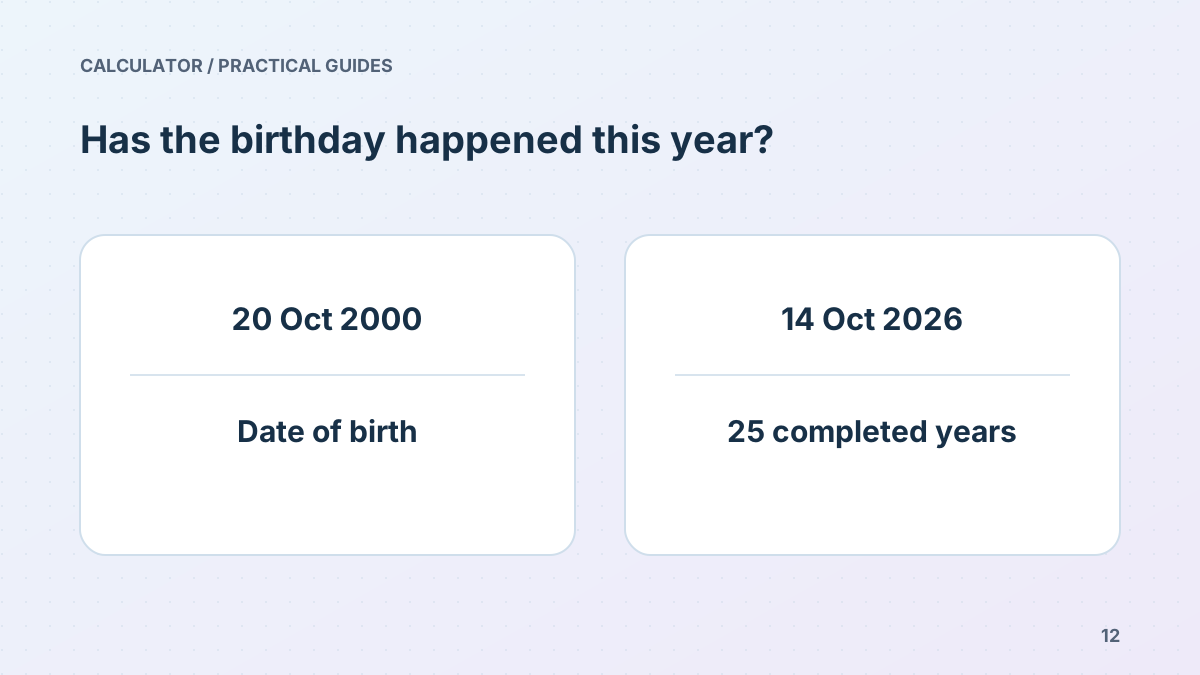
Someone born on October 20, 2000 is 25 years old on October 14, 2026, even though subtracting the years gives 26. Their birthday has not yet occurred in the reference year.
Age in completed years is a calendar comparison. Counting elapsed days and dividing by 365 answers a different question, because years do not all contain the same number of days.
Subtract years, then compare month and day
Start with reference year minus birth year. Then subtract one if the reference month and day fall before the birthday in that year. For the example, 2026 − 2000 = 26, and the October 20 birthday is still ahead, so the result is 25.
On October 20, 2026, the birthday has occurred and the completed-years result becomes 26. The reference date should be explicit: an age calculated today may differ from age on a future application date.
A date of birth after the reference date is not an ordinary positive age. Check for reversed fields and impossible dates before interpreting a result.
Why dividing by 365 does not replace birthdays
Leap years add days to the elapsed interval. Even using an average year length does not guarantee the same completed-years answer near a birthday. An average-duration calculation measures a fractional number of average years, rather than whether a particular birthday has been reached.
Days alive can be useful when that is the question you want answered. Just keep it separate from age in completed calendar years. A calculator may display both, but the labels should make their different definitions clear.
Years, months, and days depend on convention
A result such as “25 years, 11 months, 24 days” usually counts whole calendar years, then months, then remaining days. Calendar months have different lengths, so that breakdown should not be reconstructed by assuming every month has 30 days.
Month-end dates create additional questions. Moving one month forward from January 31 needs a rule because February has no 31st. A tool may clamp to the last day of the month or use another convention. Check its explanation when that edge case affects your use.
Leap-day birthdays need an explicit rule
A February 29 birth date has no identical month-and-day in a non-leap year. For informal use, people may choose a birthday convention. For an eligibility or legal-age question, the applicable authority’s rule matters; a general calculator cannot establish it for every jurisdiction.
Use a calendar-age result as an arithmetic aid, not proof that an official eligibility condition has been met. Confirm the reference date and relevant rules with the organization making the decision.
To make an age result reproducible, state the birth date, the reference date, whether you mean completed years or an elapsed duration, and any convention for unusual dates. Those details are more reliable than simply reporting a number with no date attached.
Try the calculation
Use the Age Calculator with your own inputs. Check units, assumptions, and the worked example before interpreting a result.