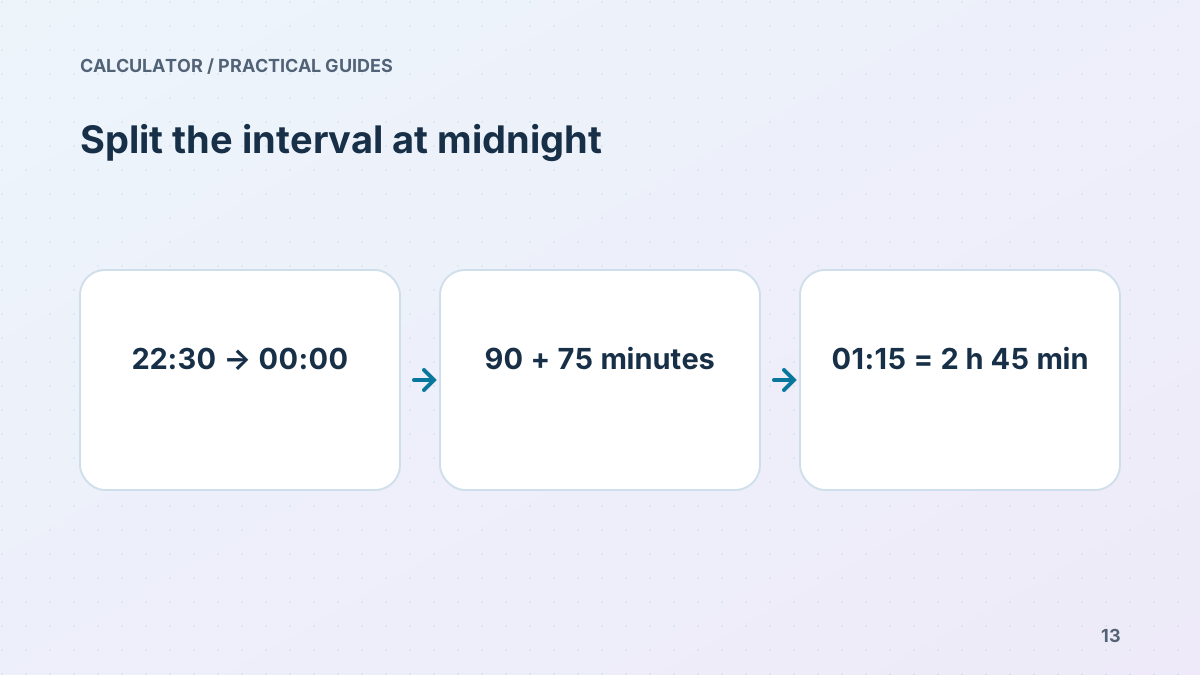
An event starts at 22:30 and ends at 01:15 the following day. Its duration is two hours and 45 minutes. Subtracting the clock readings directly gives a negative number because the ending clock has restarted after midnight.
The key is to attach a day to the ending time. “01:15 the next day” is more information than “01:15,” and that information determines the interval.
Convert each reading to minutes
Write a 24-hour reading as total minutes = hours × 60 + minutes. The start is 22 × 60 + 30 = 1,350 minutes after midnight. The end is 1 × 60 + 15 = 75 minutes after its midnight.
Because the end is on the following day, add 1,440 minutes to its position on the timeline. The calculation is (75 + 1,440) − 1,350 = 165 minutes.
Divide 165 by 60: there are two full hours with 45 minutes remaining. The duration is 2 h 45 min, or 2.75 decimal hours.
Decimal hours are not clock notation
Two hours and 45 minutes is 2.75 hours, not 2.45 hours. The minutes are a fraction of 60: 45 ÷ 60 = 0.75. Conversely, 2.5 hours means two hours and 30 minutes.
This distinction is important in spreadsheets, work logs, and travel calculations. If a field accepts decimal hours, convert the minutes first. If it accepts hours and minutes separately, enter the clock-style components.
Use dates when the interval might exceed a day
Adding one day works for this example because the end is explicitly the following day. If the event ends two days later, add two days instead. A pair of clock readings alone cannot tell you how many midnights passed.
Even a later ending clock time can belong to the next day. A start at 09:00 and an end at 10:00 might mean one hour or 25 hours. Record full dates whenever that ambiguity is possible.
Time zones and clock changes need separate handling
The simple minute method assumes the same time zone and no clock adjustment during the interval. Daylight-saving changes can create repeated or skipped local times. A clock difference during that transition may not equal the real elapsed duration.
For a flight or an event spanning zones, convert both timestamps to a common time basis using their actual offsets. Do not subtract local arrival and departure clocks as though they shared a zone.
For an ordinary overnight schedule, state the start time, end time, end day, and any breaks you subtract. If the raw duration is 165 minutes and there is a 15-minute break, the remaining time is 150 minutes, or 2.5 hours. Keeping those steps separate makes the final result straightforward to check.
Try the calculation
Use the Time Converter with your own inputs. Check units, assumptions, and the worked example before interpreting a result.